













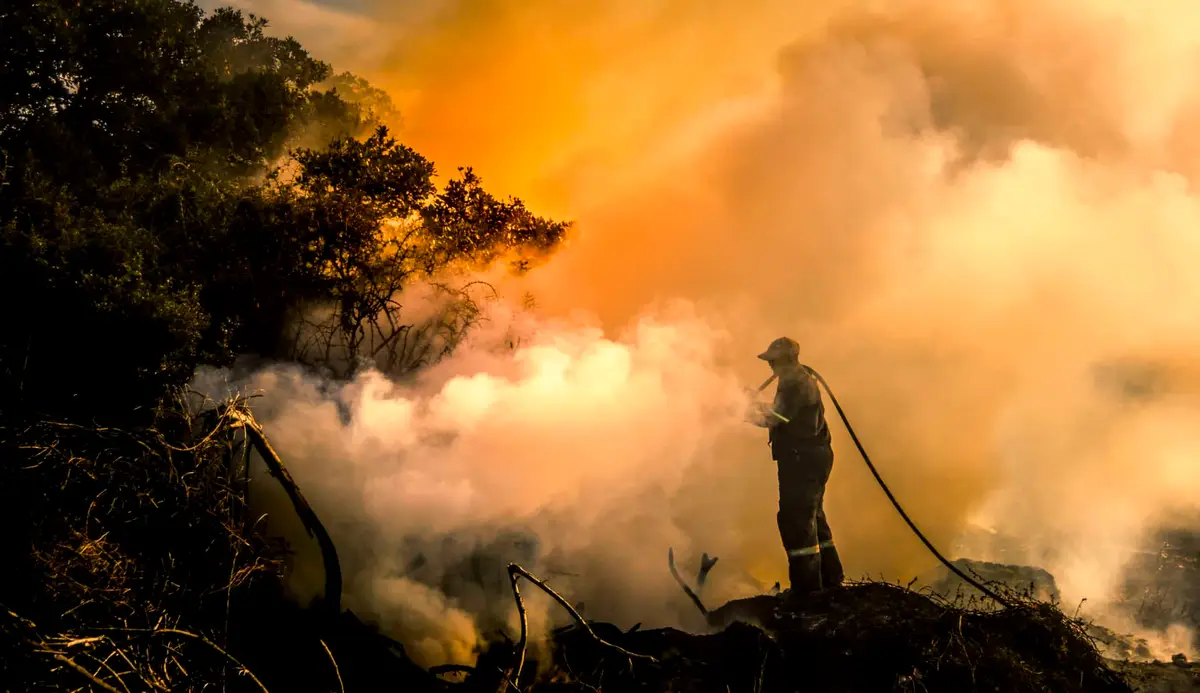

Since Sunday 25 June, huge clouds of smoke from Canada have blanketed the skies over Europe, affecting the entire continent. Carried by prevailing winds from across the Atlantic, these fine particles – emitted by the forest fires currently ravaging Canada – are crossing the ocean and spreading across Europe. France has not been spared, with the “Three-quarters of the country is affected by the smog this Tuesday; the whole of France will be affected in the coming days”, explains The Weather Channel in *Le Figaro*.
According to Régis Crépet of La Chaîne Météo, "The prevailing winds generally blow from west to east". These winds blow across the Canadian Rockies, picking up plumes of smoke from Alberta and Quebec. The smoke converges and is then carried by high-altitude winds towards Europe. The expert explains that the mechanism is similar to that of clouds.
Large amounts of smoke from wildfires raging across Quebec, Canada, are set to reach Western Europe in the next few hours. pic.twitter.com/Uxx402al87
— Nahel Belgherze (@WxNB_) 25 June 2023
The plumes of smoke reached the European coast on Sunday and then spread inland. They are expected to dissipate as they move towards the Mediterranean. Régis Crépet describes the situation in Île-de-France, where a faint whitish mist, resembling a veil, can be seen amongst the clouds at an altitude of around 5,000 metres.
However, most of the particles dissipated during the journey. During their journey of several thousand kilometres over the Atlantic Ocean, a large proportion of these particles fell due to the force of gravity, thereby reducing the density of the cloud.
Listen to “Wildfires in Canada: what you need to know about the smoke that is starting to affect France” on Spreaker.According to the expert, there is therefore very little impact on air quality, and the phenomenon is more spectacular than genuinely dangerous to the health of the French population. Although a few particles do fall back onto French territory, their proportion is so small that it does not affect air quality forecast models.
However, the peak in smoke density has not yet been reached. The meteorologist explains that the densest plume of smoke will be over France by the middle of the week, probably on Wednesday or Thursday. Nevertheless, the situation will be very different from that experienced in New York a few weeks ago. Indeed, the American city had been shrouded in very thick orange clouds of smoke, leading to a significant spike in pollution levels. Régis Crépet explains that New York was only two hundred kilometres from the Canadian forest fires, which had severely degraded air quality due to the density of the smoke.