













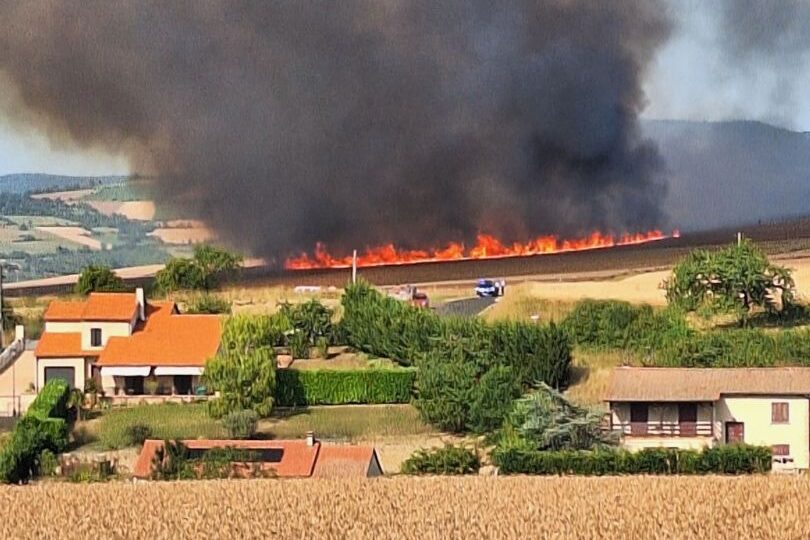
As this scorching summer gets underway, the first reports of rising temperatures are causing concern: in several departments — from the Charente-Maritime to the Vosges — Firefighters are regularly called out to contain these fires during the harvest. In the majority of cases, the fire starts in the stubble, which is highly flammable crop residue.
These fires can spread at a rate of up to one hectare per minute when the right conditions are present: heat, drought and wind. Last summer, a harvest fire in the Aube department destroyed more than 60 hectares of crops in less than two hours.
Multiple causes, often human in origin
In nine out of ten cases, these fires are caused as a result of human activity : an overheated exhaust, a poorly maintained combine harvester, a cigarette end thrown from a road, or even a simple spark. Sometimes, a fire starts without the farmer realising it, at the rear of a machine.
“All it takes is a poorly lubricated ball bearing to set a whole field alight,” explains a farmer from the Beauce region, who faced a fire in 2024. “Fortunately, I had my water tank to hand. But it all happens very quickly.”
Constant vigilance
In the face of mounting risk, the chambers of agriculture and prefectures are issuing an increasing number of warnings. The aim is to encourage farmers to prepare for their harvests in the same way as one prepares for a fire-fighting campaign.
The recommendations include:
- Regularly plough the field margins to create firebreaks.
- Reaping against the wind.
- Each vehicle must be fitted with a fire extinguisher.
- Keep a water tank or water barrel on the premises.
In some departments, such as the Cher, a prefectural order even imposes these measures during periods of heightened vigilance.
A high-risk season
For the past few years, the fire season is getting longer. These days, the first departures can take place as early as June, or even late May, and the season sometimes lasts until September. Climate change is a major factor in this: periods of drought are becoming more severe and summer winds are becoming more frequent.
“We’ve gone from a summer of vigilance to a summer of constant crisis,” sums up one officer. “Crop fires are less conspicuous than forest fires, but they’re just as dangerous.”
On the front line: farmers
For the latter, there are two key challenges: protecting their livelihoods… and preventing the fire from spreading to neighbouring wooded areas. On the edge of scrubland or pine forests, a simple stubble fire can quickly turn into a nightmare.
“Every year, I work with a knot in my stomach. As soon as the combine harvester starts up, I look up at the sky, listen to the wind and scan for the slightest wisp of smoke,” says a cereal farmer. “It’s no longer just a harvest. It’s a race against the fire.”
In the event of a fire: what to do
The fire service reminds the public that in the event of a fire:
- We must call 18 or 112 immediately.
- Please specify the exact location (field name, GPS coordinates, access).
- Do not take unnecessary risks.
A long-term threat
Whilst the vast majority of crop fires remain contained, their increasing frequency is a cause for concern. In 2024, more than 4,000 hectares of crops went up in smoke in France in July alone. For farmers, it is also an economic issue, with losses that are sometimes not covered by insurance, particularly where the fire was started deliberately.