










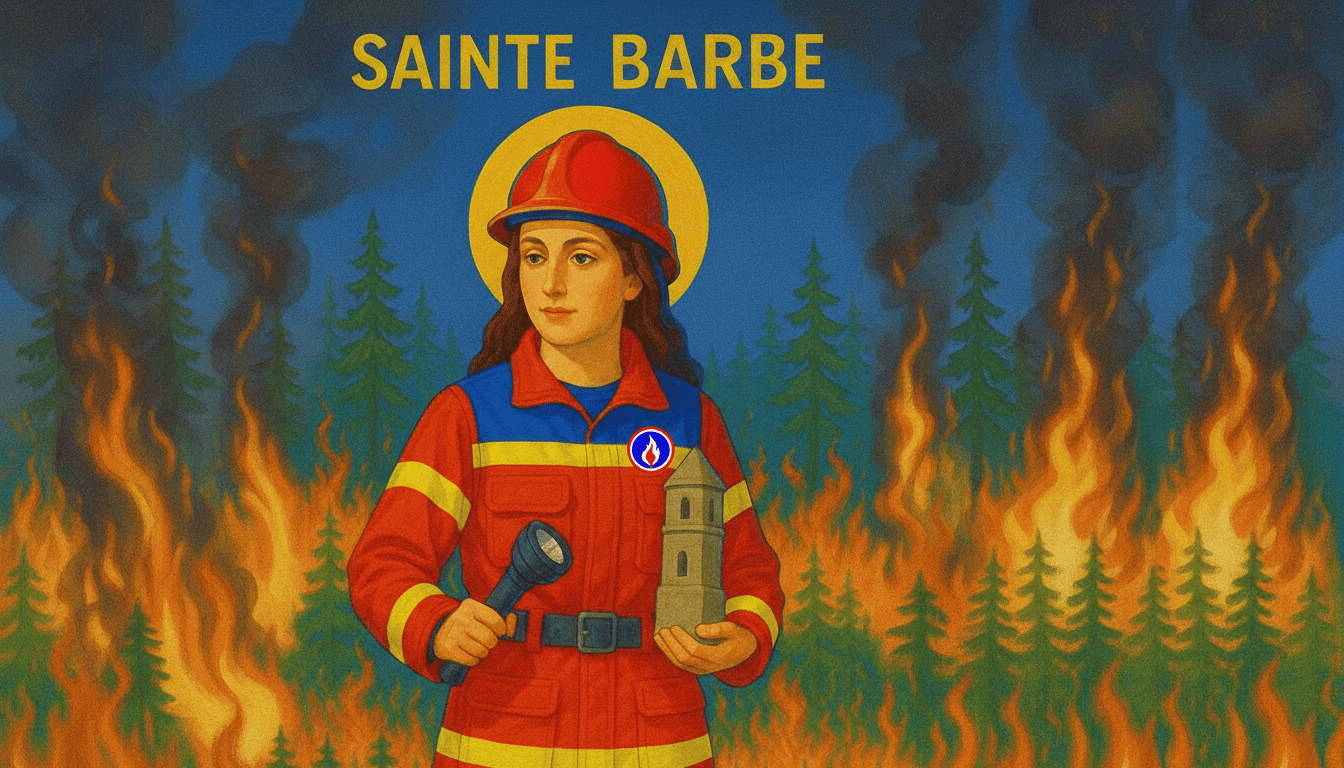

The Saint Barbara, celebrated every year on 4 December, is one of the most important traditions in the fire service. This figure, blending history, legend and folk tradition, has for centuries symbolised protection from danger and the spirit of solidarity that is so characteristic of firefighters. Even today, this celebration brings together volunteers, professionals and retired firefighters around a shared heritage that is deeply rooted in their collective identity.
The legendary origins of Saint Barbara
According to Christian tradition, Saint Barbara is said to have been born in the 3rd century in the region of Phoenicia, probably in Heliopolis/Baalbek, within the Roman Empire. Her father, Dioscore, a high-ranking pagan official, is said to have confined her to a tower to preserve her beauty and control her upbringing. During this period of isolation, the young woman is said to have secretly converted to Christianity, an act considered an act of betrayal by her father.
On his return, upon discovering her new faith, Dioscore denounced her to the Roman authorities. Barbe was tortured and then sentenced to death, and legend has it that her own father carried out her execution before being struck down by lightning himself as a form of punishment. Whilst this account is highly hagiographic, historians agree that no ancient source attests to Barbe’s actual existence, emphasising the legendary nature of the saint and her martyrdom.
Why did Saint Barbara become the patron saint of firefighters?
The fate attributed to Dioscore, who was struck down by lightning, quickly established Saint Barbara as a patron saint against violent phenomena associated with fire: explosions, thunderstorms, fires, collapses and the handling of gunpowder. She has thus established herself as the patron saint of professions exposed to pyrotechnic and thermal risks: miners, artillerymen, pyrotechnicians… and, of course, firefighters.
For firefighters, she embodies the idea of protection as they carry out their daily duties. Saint Barbara also symbolises courage in the face of danger, loyalty to colleagues and the self-sacrifice inherent in a profession based on commitment and rescue. Through this figure, firefighters find a cultural and moral anchor passed down from generation to generation.
St Barbara’s Day: a time for camaraderie in the barracks
Celebrated since the Middle Ages amongst those working with fire, Saint Barbara’s Day has gradually become an established part of the fire service’s culture, becoming an unmissable event in the professional calendar. Today, whilst the religious aspect has faded, the event retains strong symbolic and unifying significance.
Many fire stations organise official ceremonies, which include the awarding of ranks and honours, as well as tributes to fallen colleagues. These solemn occasions serve as a reminder of the profound nature of firefighters’ commitment and strengthen the bonds between volunteers, professional firefighters, senior staff and retired personnel. Following the ceremonies, social gatherings give everyone the chance to come together to share a meal, reflect on the past year and welcome new recruits.
St Barbara’s Day thus marks a time of unity and remembrance, which is essential for a profession that is often put to the test. It also serves as a reminder that behind every operation there is a close-knit community, built on mutual support and the passing on of the profession’s values.