












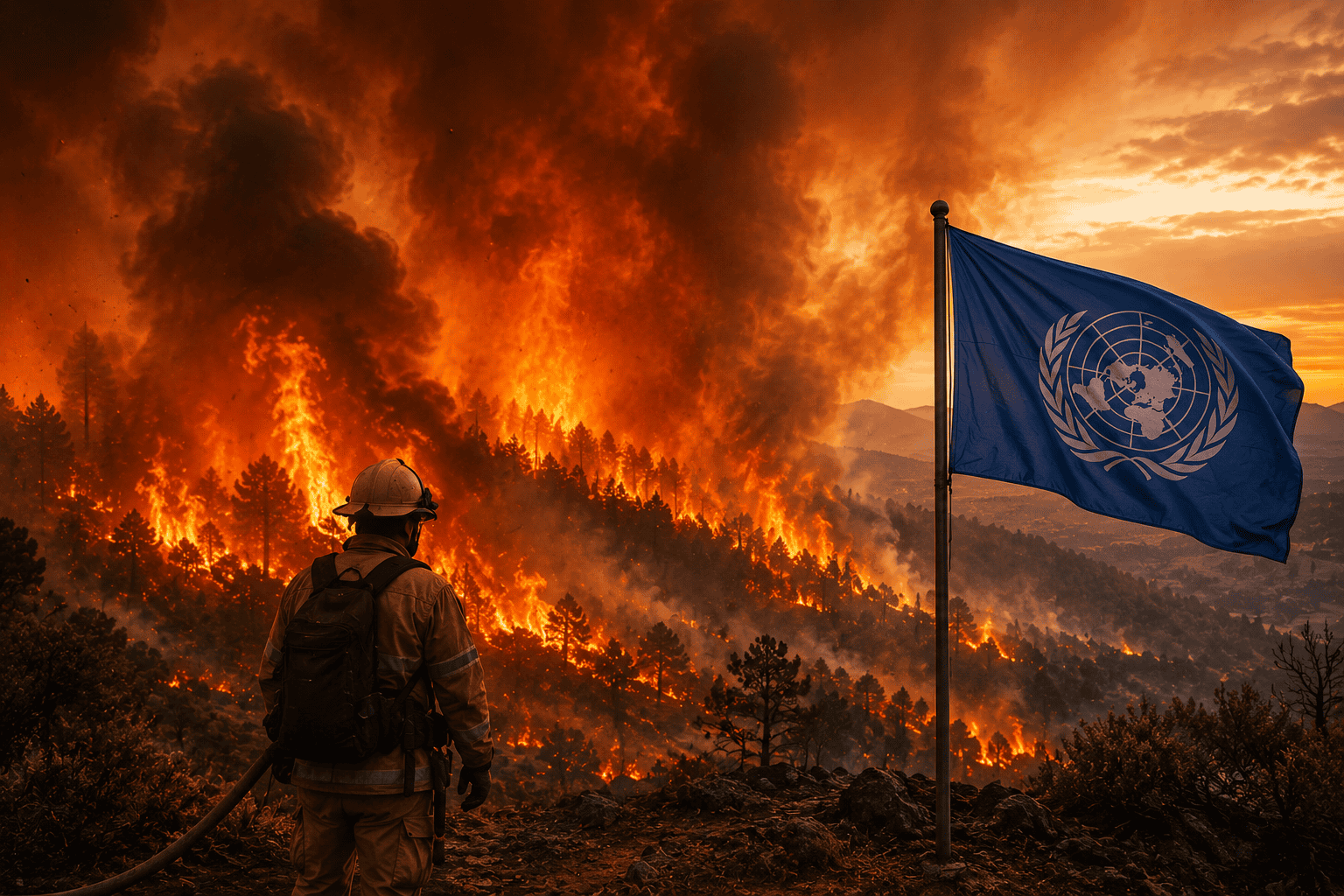
Since the 1ster By January 2026, more than 150 million hectares of vegetation had been ravaged by fire across the world, according to a warning from the United Nations (UN) issued on 12 May. The scientific data is even slightly more alarming: the total area burnt is estimated to be 163 million hectares as at 6 May, according to the Global Wildfire Information System (GWIS), compared with an average of 110 million over the period 2012–2025 at the same date. This is equivalent to 630 times the area of Luxembourg.
“This year, the global wildfire season got off to a very strong start, with 50 per cent more land burnt than the average for this time of year,” as Theodore Keeping, a researcher at Imperial College London, pointed out. According to him, the previous record set since global satellite monitoring began in 2012 has already been exceeded by 20 per cent.
Africa, the United States: already spectacular wildfires
The trend is particularly pronounced in Africa, with record levels in many countries in West Africa and the Sahel. Savannah fires there have been fuelled by a phenomenon known as a ‘climate whip’, which sees heavy rains – which encourage vegetation growth – alternating with periods of drought that are conducive to fires.
In the United States, the season got off to an unprecedentedly intense start: Fires have already burnt 127 per cent more land in 2026 than the ten-year average, following one of the warmest and driest winters ever recorded in the West. In Florida, nearly 120,000 acres have been burnt since the start of the year, whilstIn Georgia, two major fires have ravaged more than 50,000 acres, one of which became the most destructive in the state’s history.
France has been relatively unscathed… for now
Unlike many parts of the world, mainland France is enjoying a temporary respite. Météo-France has reported that January 2026 was characterised by numerous spells of bad weather following a very cold start to the year, with heavy rain, particularly in Brittany, Roussillon and Corsica.
Consequence: As at the end of April 2026, no major forest fires had been reported in Auvergne-Rhône-Alpes, and the region remained on early warning alert in the spring due to residual drought and human activity. The authorities describe the situation as “a moderate but real fire risk”, given that the rainy winter has kept the vegetation green. Caution is nevertheless still advised, as the summer season has not yet begun.
El Niño, the aggravating factor
The worst may yet be to come. According to the World Meteorological Organisation (WMO), surface temperatures in the equatorial Pacific are rising rapidly, suggesting that El Niño is likely to return as early as May to July 2026.
Météo-France states that some seasonal forecast models suggest an event so intense that it could be described as a ‘super El Niño’. Combined with long-term warming, this episode could push the global average temperature in 2026–2027 towards, or even beyond, the record set in 2024.
“The likelihood of extreme and dangerous fires could potentially be the highest in recent history if a powerful El Niño develops,” says Theodore Keeping. The phenomenon could increase the likelihood of very hot and dry conditions in Australia, the north-west of the United States and Canada, and the Amazon rainforest.
A major threat to human health
Apart from direct losses, smoke from wildfires is a major cause of silent mortality. According to figures released by the UN, exposure to this smoke is thought to cause around 339,000 deaths per year worldwide.
The Australian example is telling: during the ‘Black Summer’ fires of 2019–2020, the flames caused a few dozen direct deaths, but the smoke led to several hundred further deaths and thousands of hospital admissions for cardiovascular and respiratory problems.
“I see children struggling to breathe due to asthma flare-ups, and elderly people whose heart conditions worsen when the air becomes unbreathable,” says Dr Courtney Howard, President of the Global Climate and Health Alliance, speaking on behalf of the UN. She herself was evacuated from her hospital during the Canadian wildfires of 2023.
A global trend that is getting worse
The fundamental finding is now well documented: extreme fires are on the rise. According to the United Nations Environment Programme (UNEP), experts predict a global increase in extreme wildfires of up to 14 per cent by 2030, 30 per cent by 2050 and 50 per cent by the end of the century.
“These figures are even more stark evidence that global warming — fuelled by pollution from coal, oil and gas — is wreaking havoc across a staggering proportion of countries,” warns Simon Stiell, Executive Secretary of the United Nations Framework Convention on Climate Change (UNFCCC).
The call to action ahead of COP30
The UN is urging countries to “drastically reduce their consumption of fossil fuels” and achieve carbon neutrality. Simon Stiell highlights an economic argument: “Every dollar invested in adapting to climate change saves more than 10 dollars in damage.”
This issue will be at the heart of the COP30, which will take place in Belém, Brazil, from 10 to 21 November 2026, where forest protection is one of the priorities announced by the Brazilian presidency.