











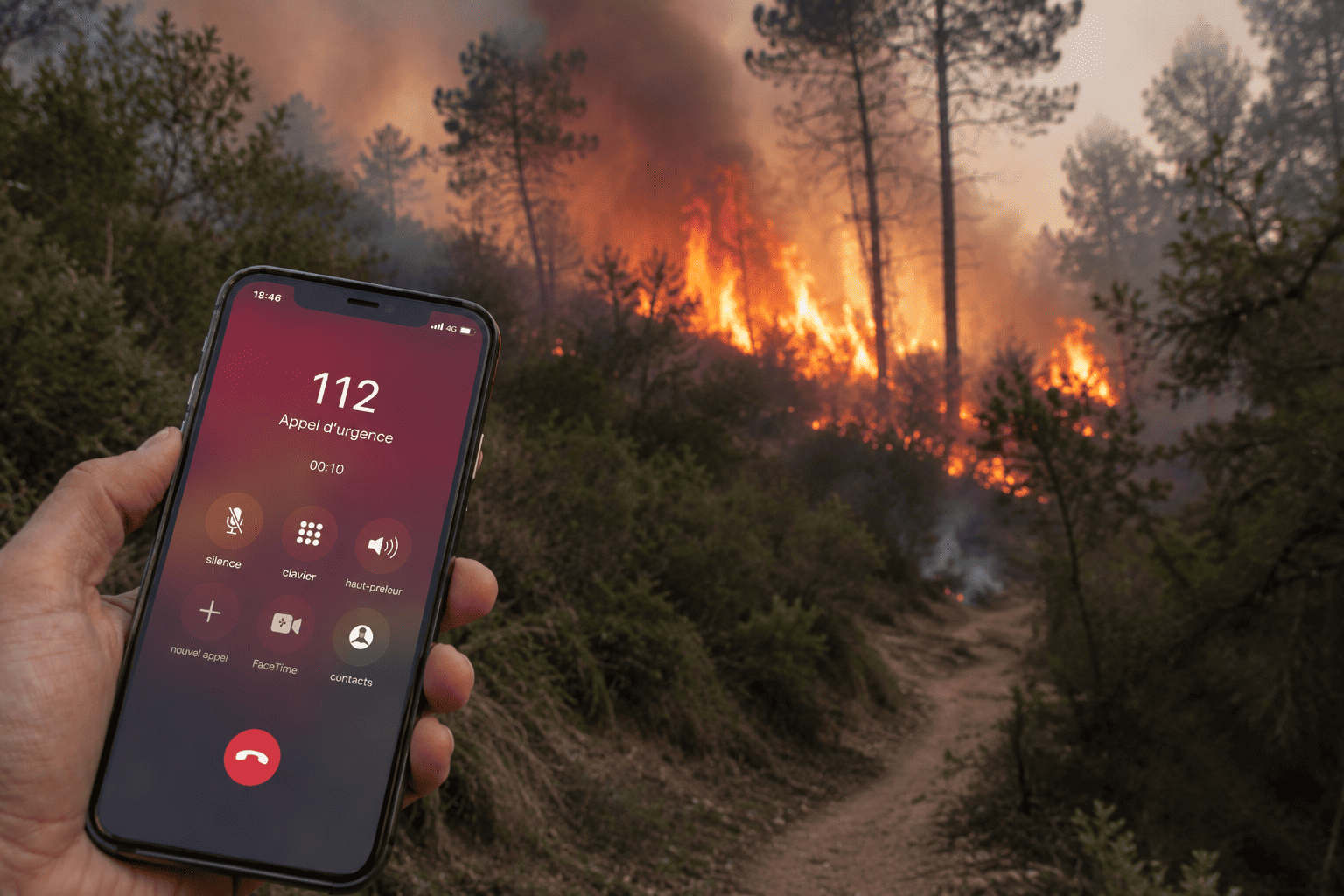
When faced with suspicious smoke or a fire breaking out, every second counts. Whilst 18 remains the traditional number for the fire service, 112 — the European emergency number — offers key advantages, particularly in wooded or remote areas where fires often break out. Here’s why dialling this number can save lives.
“A forest fire that has just broken out is tackled ‘with a glass of water in the first minute, a bucket of water in the second, and a water tanker in the third’,” recalls the founding president of Forest Fires. After ten minutes, aerial resources become essential. In other words: the speed of the alert is the key factor in extinguishing the fire. And this is precisely where the choice of number can make all the difference.
112 works even when your mobile network has no signal
This is the most practical benefit for someone who spots a fire breaking out. Wildfires frequently break out in the countryside, in woodlands, at the side of the road or in the mountains — areas where mobile phone coverage is often patchy.
However, the 112 number benefits from the emergency roaming : if your operator’s network is unavailable, your phone will automatically switch to another operator’s network in the area to complete the call. When your screen displays ‘Emergency calls only’, this simply means that another network is within range and that 112 can still be reached. Operators are legally obliged to route these calls, even if a rival SIM card is being used. The only limitation is that in a complete ‘dead zone’ with no network coverage at all, no calls can be made.
Automatic geolocation of the caller
Since April 2020, France has rolled out the technology AML (Advanced Mobile Location) for calls made to both 112 and 18. In practical terms, when you call the emergency services from a modern smartphone, the device automatically sends its precise GPS location via text message — with an accuracy of just a few tens of metres, compared with several hundred metres, or even kilometres, using older methods.
Originally designed around the 112 emergency number and introduced by a European directive, this system is particularly useful if you witness a fire but do not know the exact locality or the name of the mountain range where you are.
A single number, always correctly oriented
The 112 has another advantage: it eliminates any hesitation. It is the only number you need to remember, and it works in all 27 countries of the European Union. In France, calls are automatically routed to the relevant service: in around 90 per cent of departments, calls to 112 go directly to the fire service, just like calls to 18. In certain pilot regions, such as Île-de-France, calls are routed to a joint 15/18 call centre.
For a panicked witness — or for a child who has been taught this number — dialling a single key number without having to ask themselves, ‘Fire brigade, ambulance or police?’ saves precious time.
18 or 112: what do the authorities say?
Let’s be clear: the Home Office continues to recommend that 18 when you are in France and the situation involves a fire. Official forest fire prevention websites consistently state ‘18 or 112’, as both numbers usually connect to the same emergency call centre (CTA). The operator at the other end of the line knows which number has been dialled, but handles the emergency in the same way.
112 is therefore not a substitute for 18: it is an alternative that is at least as effective, and often safer when mobile network coverage is unreliable — which is frequently the case when dealing with a wildfire.
Raising the alarm effectively: the key actions to take
Whichever number you dial, the effectiveness of the emergency services depends on the quality of the call. You must:
- Stay calm and focused. Please provide your name and a number where we can call you back.
- Locate the fire as accurately as possible: mountain range, local place name, access road, kilometre marker. On the motorway, use the orange markers every 2 km.
- Describe the nature of the fire : grass, scrub, pine forest, extent, direction of spread.
- Take shelter next, without attempting to put out a fire that has already started.
- Please do not overload the lines : If the emergency services have already been alerted, please only call again to provide new information.