













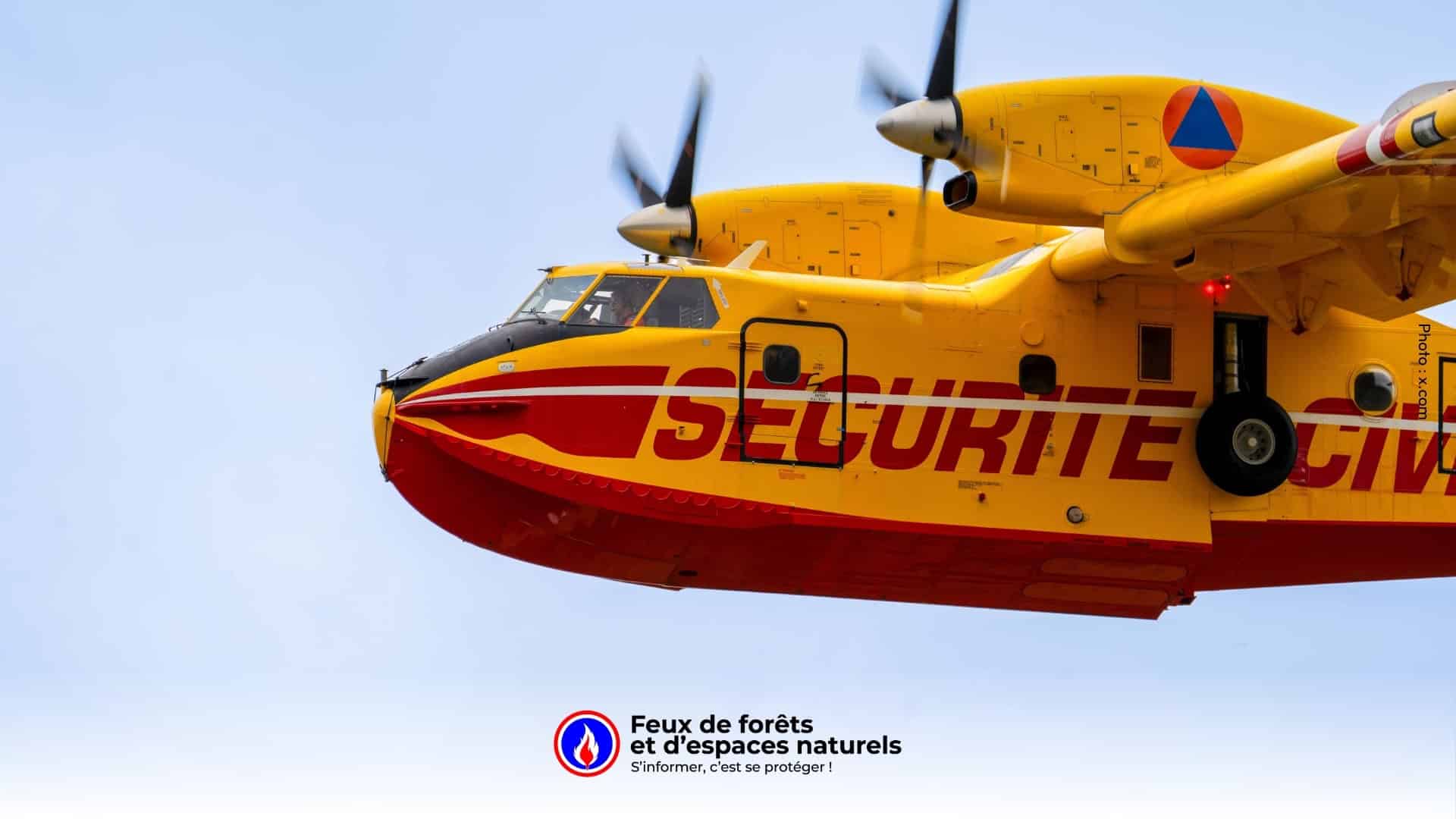

France has taken a further step forward in modernising its forest fire-fighting capabilities. At the launch of the national prevention campaign in Nîmes on Thursday 4 June 2026, the Minister for the Interior, Laurent Nuñez, signed off on the order for two new Canadair DHC-515 aircraft. These aircraft, which are expected to be delivered between 2032 and 2033, represent an investment of nearly 200 million euros for the State.
A long-standing commitment to civil protection
This order follows on from the announcements made by Emmanuel Macron in the wake of the devastating fires of summer 2022. It complements the first two DHC-515s ordered in 2024, which are due to be delivered in April and November 2028. Ultimately, the civil protection fleet is set to comprise 16 amphibious water-bombing aircraft – an ambitious target designed to tackle the increasing risks associated with climate change.
The restart of the assembly lines at De Havilland, the sole manufacturer of Canadair aircraft, was made possible by a European order for 22 new-generation aircraft. Laurent Nuñez emphasised that France would ensure delivery schedules were met, whilst relying on the dynamism of French industrial players, such as Kepplair and Hynaero, who are working on water-bombing aircraft projects with trials currently underway.
An ever-changing fleet of aircraft
The current fleet already comprises eight Dash 8-Q400MRs, three Beechcrafts, as well as water-bombing helicopters and Air Tractors hired each summer. However, the National Federation of Fire Brigades pointed out in a statement that France could not simply sit back and wait for deliveries from abroad. It is calling for the development of French and European production capacity for water-bombing aircraft, whilst warning of the 54.7 per cent reduction in funding for structural investment in the SDIS.
The stakes are immense: the summer of 2025 saw nearly 15,000 fires break out in France, affecting 30,000 hectares of forest and vegetation. Of these, 1,800 forest fires ravaged 20,000 hectares, including major blazes such as the one in the Corbières mountains in the Aude department in August 2025.
Greater vigilance at national and European level
The risk of wildfires is no longer confined to the south of France. Around 50 departments, including the Côtes-d’Armor and the Seine-et-Marne, are now on the list of areas classified as high-risk. At European level, the European Union has pre-positioned nearly 800 firefighters in high-risk areas, such as Spain, Greece and Italy. France, for its part, will host four European forest fire response units, notably in the Bouches-du-Rhône and Gironde departments.
This announcement comes as the nine firefighters’ unions, meeting as an inter-union group, called on the government last week to address the urgent need to reform the funding of the SDIS, a system on the brink of collapse.