








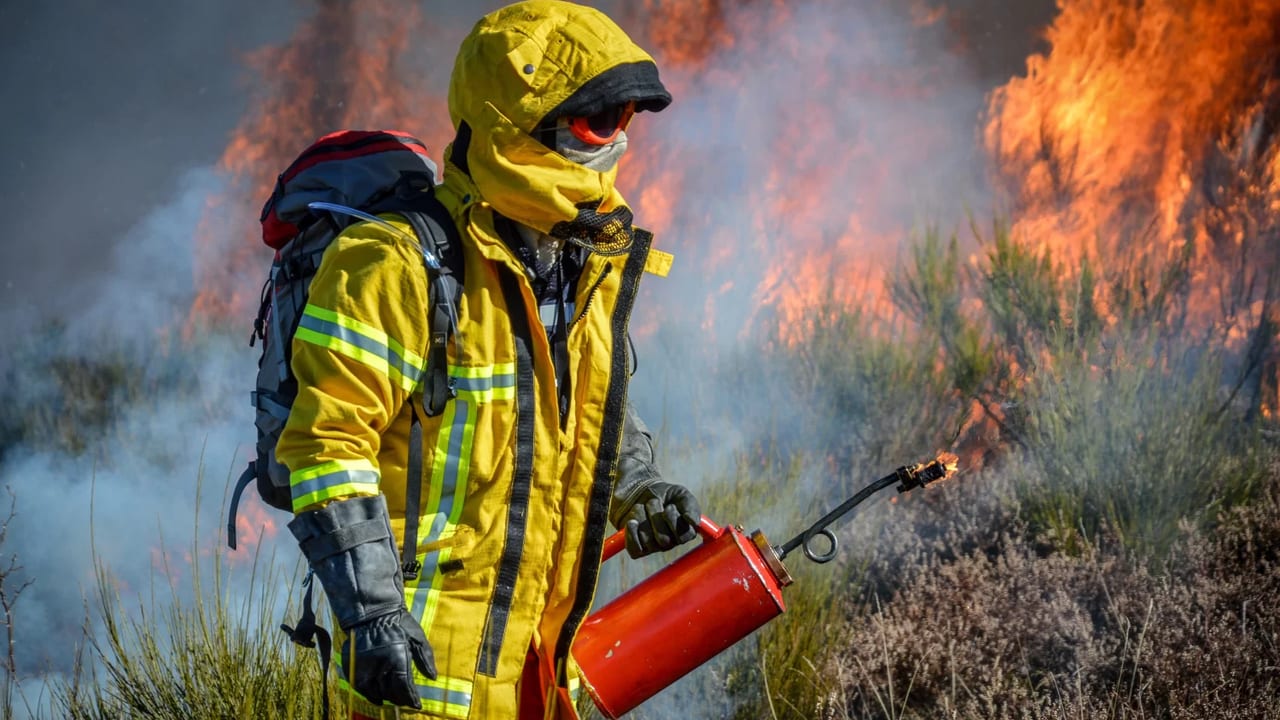
Every summer, the same images are shown: a firefighter, torch in hand, setting fire to the vegetation in front of a blaze. Every summer, the same reactions follow — bewilderment, anger, and sometimes accusations. These men and women are not arsonists in uniform: they are burners, a handful of specialists who have spent years training in the most counter-intuitive aspect of fighting forest fires. An investigation into a French expertise that has long been practised behind the scenes, is now enshrined in law — and is more essential than ever.
Key points to remember
- It’s not a fire, it’s a weapon. Tactical burning (backfire and tactical burning) involves removing fuel from the path of the flames. It has been enshrined in Article L131-3 of the Forestry Code since 2004 and may only be authorised by the head of rescue operations.
- No improvisation. To become a tactical fire officer, you need the FDF3 qualification, the controlled burning site manager’s certificate, 80 hours of training in Valabre — and ten supervised operations every five years to maintain your qualification.
- Science backs it up, without exaggerating. Controlled burns reduce the severity of subsequent fires by an average of 16 per cent; the debate remains open as to the net impact of the smoke, an issue which the French network is explicitly investigating.
One night in July, between Le Porge and Lège-Cap-Ferret
On the night of 23–24 July 2026, the Gironde mountain range in the Landes region was ablaze. Having started in Saumos, the fire has already spread across more than 10,000 hectares, and the Home Secretary, Laurent Nuñez, has described it as the biggest fire of the season. The images are being shown on a loop: 140,000 people evacuated, the Cap-Ferret peninsula emptied by the sea and by land, and hundreds of buildings affected.
And then, in the middle of the news reports, this clip: firefighters, torch in hand, deliberately set fire to on the moor.
The Prefect of Gironde, Sophie Brocas, confirmed this publicly the very next day: throughout the night, controlled burns had been set to contain the fire. The aim, in her words, was to “pincer it in to stop it” — and it worked.
On social media, the reaction was immediate. Bewilderment. Suspicion. Sometimes insults. This feature addresses these messages.
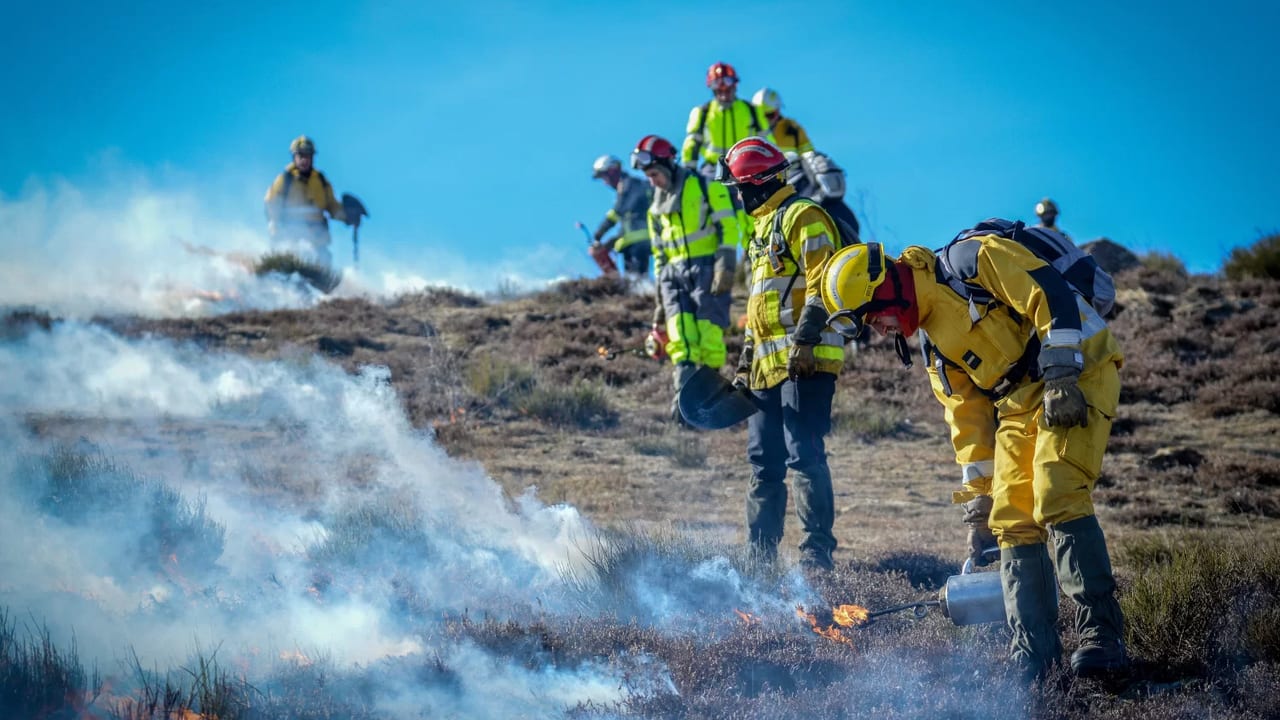
A tactical fire is always set from a safe area, under the cover of a fire support unit.
Two techniques, one principle: removing food from the heat
A forest fire depends on three things: fuel, oxygen and heat. There is nothing we can do about the oxygen. There is little we can do about the heat from a fire front at full strength. That leaves fuel.
This is where the use of fire comes into play; in France, this term covers two distinct concepts that must never be confused.
Controlled burning: prevention in winter
Controlled burning is an operation scheduled, carried out outside the summer season, within a pre-defined area and with the landowners’ consent. Regulatory requirements stipulate that grass, scrub, litter and logging residues must be destroyed by fire, as their accumulation would encourage the spread of a future fire. It is a planned operation, not an emergency: it is prepared months in advance, carried out during a specific weather window, and halted if even a single factor falls outside the specified parameters.
Tactical fire: the struggle, in summer
Tactical fire, on the other hand, is decided during fire. It involves two steps:
- The backfire : a fire is lit ahead of the main fire front, using a safe area (track, clearing, road) as a barrier. This fire spreads towards The fire spreads and consumes the fuel in its path. When the two fronts meet, there is nothing left to burn: the fire goes out of its own accord.
- Tactical burning : a controlled burn is carried out along the edge of a fire to contain and reduce it, to fully extinguish a fireline that is threatening to reignite, or — in extreme cases — to create a refuge area and bring personnel to safety.
These two actions fall within the scope of theindirect attack. French military doctrine remains unchanged: priority is still given to a direct assault, on the ground, using land and air assets. Tactical fire is only employed when such a direct assault is impossible or doomed to failure.
Physics: what the camera doesn’t show
The general public sees two lights. Experts see two convection columns.
A flame front draws in air at its base to fuel the combustion. Two flame fronts facing each other create two air inlets that draw in air from one another. The result is that, instead of escaping towards the rear, the backdraft is literally drawn towards the fire. It is this phenomenon that fire-makers exploit — and it is also why this technique can never be improvised: if misjudged, it produces exactly the opposite effect.
In April 2004, the Gard fire service and CEREN carried out a full-scale trial near Le Vigan on two identical 3,000 m² plots, fitted with thermocouples and test dummies. The results speak for themselves:
- On the plot treated with a backfire, the igniters worked in bearable temperatures whilst wearing fire-resistant suits — with a maximum temperature recorded at around 60 °C — and water consumption was limited to a few hundred litres.
- On the plot left to spread unchecked, the radiant heat from the rising flames exceeded 250 °C on the track. It was impossible for anyone to be present there. The test dummy was completely consumed; a leather jacket placed eight metres from the vegetation burnt on the second test.
In other words: the backfire does not make the scene any more dangerous. He makes it workable.
Aumessas, 9 August 2003: the night it all began
It is 3.51 am in the Cévennes region of the Gard. A forest fire response team has just failed in a direct attack further down the slope. They have withdrawn to the top of the slope, onto a track. Below them, the fire is spreading upwards through broom and conifers. The flames are reaching a height of around ten metres.
The commander of the rescue operations, Commander Nicolas Coste, would later describe the scene in no uncertain terms: fear was written all over their faces, and waiting for the fire to reach them in that position was out of the question — its intensity far exceeded the fire engines’ water-supply capacity.
He decided to light a backfire.
Two members of staff are lighting the trail with torches. The response team is responsible for safety, ensuring the fire spreads along the trail and monitoring any flare-ups. And then something happens that the manuals don’t mention: team morale is on the rise. The fire is now very close by — but it is moving away from them, towards the blaze. Fear gives way to concentration.
At 5.56 am, the fire had spread 600 metres further. The backfire was directed downwards to meet the main fire. The two fronts merged into one, then died out. The rest of the night was spent tackling the flanks using water, in the usual way.
In the summer of 2003, seven departments used tactical fires. It was this feedback that brought about a change in France’s approach.
Coming out of hiding: a French story
Let’s be clear: for decades, this technique has been practised in the shadows.
The practice of using fire to combat fire is, however, an ancient one. A law of 1870 concerning the Maures and the Estérel already authorised, outside periods of prohibition, the use of a ‘small fire’ to clear woodland separated by protective trenches. However, this authorisation was accompanied by such severe criminal penalties that subsequent legislation did not retain the provision.
The result was that, until the early 2000s, an officer setting a backfire was operating within an uncomfortable legal grey area. The 1978 regulations governing the operations of municipal fire brigades provided a framework for backfires; it was repealed on 1 January 2002 without being replaced. What remained were the Forestry Code, which restricted the use of fire to landowners, and the Criminal Code — which could either prosecute for arson or exempt the perpetrator on the grounds of necessity.
It goes without saying that the subject was taboo.
The breakthrough comes from the the Civil Protection Modernisation Act of 13 August 2004, Article 26 of which explicitly recognises this technique. The provision is now codified in theArticle L131-3 of the Forestry Code : The head of rescue operations may, even without the owner’s authorisation, use tactical fires as required for fire-fighting purposes.
Controlled burning, for its part, was regulated in advance by the Forestry Framework Act of 9 July 2001, as further specified by the Decree of 29 April 2002, and subsequently by the interministerial order of 15 March 2004, which designated two centres authorised to train those responsible for carrying out such work: the Valabre School in Gardanne and the CFPPA in Bazas, Gironde.
An age-old tradition has thus become a skills that are guided, taught and assessed.
Becoming a burner: the most demanding career path in the specialism
It is here that the public’s misunderstanding clears up most quickly. Becoming a ‘firefighter-burner’ is not something you can just whip up over a weekend. It is a journey spanning several years, one that builds up over time and can be reversed.
Step 1 — The forest fire specialism
It all starts with the FDF training programme, from FDF1 (team member) to FDF5 (site manager). You don’t touch a torch until you’ve first mastered conventional firefighting techniques.
Step 2 — Controlled Burning Team Member (RTBD Module 1)
Five days, 40 hours. Entry requirements for a firefighter: to hold a FDF1. For ONF or DDTM staff: provide evidence of an understanding of the role of an FDF team member, certified by the relevant SDIS.
Step 3 — Controlled Burning Site Manager (RTBD Modules 2 and 3)
Ten days, 80 hours, at an off-site venue. Prerequisites: Module 1 successfully completed and FDF2 for firefighters. The course covers regulations, health and safety, environmental impact, site preparation and organisation, coordination of stakeholders — and practical scenarios involving the actual lighting of fires on plots of land.
But the training does not stop at the classroom. To be recognised, it requires:
- 3 days of shadowing in three different teams from his own, in different departments and contexts;
- 4 days of work experience ;
- 1 day at the national meetings within two years.
And above all: the site manager must have oversaw ten controlled burning operations over five years to retain their certificate. The employer provides the supporting documentation; the certificate is valid for five years. If the holder does not practise, it lapses.
Step 4 — Tactical Fire Control (TFC)
This is the pinnacle. Eighty hours of training at the Valabre Civil Protection Training Centre, with two sessions a year for 24 trainees. Prerequisite: holding the certificate of a site manager for controlled burning with a valid licence, and hold the FDF3 (team leader) for the fire service.
The programme reflects the high standards required: regulations, understanding fire behaviour and mechanisms, work at the column and site command posts on lessons learnt, and practical exercises involving setting fires on predefined plots, work on historic fire stations, including identifying opportunities, design of reinforcements.
This last point is worth considering. ‘Seeking opportunities’ means: learning anew, from actual fires in the past, how to identify the at the moment and the places where tactical fire would have been appropriate — and all those where it would have been disastrous. Because knowing how to light a fire means, first and foremost, knowing when not to switch on.
In 2025, the CFT training programme recorded a 100 per cent pass rate and a 96 per cent satisfaction rate. These figures say less about how easy the course is than about the rigorous selection process beforehand. These figures say less about how easy the course is than about the rigorous selection process beforehand: you cannot get onto this course without having already completed the full wildfire training programme and supervised dozens of winter operations.
Controlled burning, ‘an excellent lesson in fire’
It is no coincidence that the path to tactical fire involves mandatory through controlled burning. Practitioners put it this way: the preventive use of fire is an excellent learning experience, because it enables people to acquire the skills of lighting and controlling a fire within pre-defined geographical boundaries, without the pressure of an emergency.
It is here that a firefighter learns to read what no one else can see: wind speed, air humidity, temperature, the degree of desiccation of the vegetation, and the water content of the litter. It is here that he learns to to drive controlling the fire rather than simply enduring it, by combining the effects of wind and slope — the fire spreading downwind, slowly and with low intensity (5 to 30 metres per hour), when the terrain is highly combustible; the fire spreading along successive contour lines when a higher intensity is acceptable; fire through copses for mosaic-style treatment.
Each method serves a specific environmental and safety purpose. It’s not just pyrotechnics. It’s agronomy applied at high temperatures.
A network, not a bunch of mavericks
The other misconception concerns the supposed isolation of these teams. In fact, the opposite is true.
The Network of controlled burning teams was founded in 1990 in La Garde-Freinet, in the Var department, by the fire prevention team at the INRA in Avignon. Its original strength lay in bringing together two professions that had previously operated on opposite sides of the fire — forest rangers, on the prevention side; firefighters, on the fire-fighting side. The first structured programmes date from 1987 (Pyrénées-Orientales) and 1989 (forest fire-fighters in the Alpes-Maritimes).
Renamed Integrated Fire Service Employment Network, it now brings together hundreds of practitioners — farmers, livestock farmers, firefighters and foresters — spread across some forty departmental groups, with associated Italian and Catalan teams. Each year, a different department hosts a three-day national conference where participants share their successes… and, above all, their incidents.
In practice, this translates into very specific measures. The Bouches-du-Rhône Fire and Rescue Service (SDIS), for example, was making plans for the 2024–2025 campaign 34 construction sites covering 166 hectares, in collaboration with the ONF and the Department, outside the summer season and under the supervision of trained site managers.
One hundred and sixty-six hectares. By comparison, tens of thousands of hectares went up in smoke this summer in the Gironde mountains.
What the science says: effective, but not a miracle cure
An honest report must also set out the limitations. They do exist.
This is well established. A landmark study of the Rodeo-Chediski fires in Arizona (2002) showed that controlled burns carried out between one and nine years prior to the fires had reduces the severity wildfires and altered their spread — despite a record drought and 186,000 hectares at risk. Severity increased with the time elapsed since treatment and decreased with the area treated and the number of treatments. In the dry forests of the American West, another study demonstrated that A break in the clouds alone does not reduce the severity, but thinning followed by controlled burning, yes.
More recently, a study conducted by Stanford and published in June 2025 quantified the effect on a large scale: controlled burns reduce, on average, by 16 per cent in terms of severity subsequent fires and 14 per cent net air pollution from exhaust fumes. With one important caveat: its effectiveness is significantly greater excluding the forest-habitat interface (20 per cent) than in these buffer zones (8.5 per cent), where the agencies often favour mechanical brush-clearing.
What is being discussed. There is no consensus on the ‘smoke’ assessment. An article published in PNAS in 2026 argues that, on a global scale and under current conditions, controlled burning increases net emissions of fine particulate matter in most landscapes — whilst recognising that the technique has other objectives and benefits which make it indispensable to forest management. The French network is well aware of this: at national meetings, entire working groups have been dedicated to protecting the public and those working in the field from smoke.
What we know about soils. The measurements are reassuring when the fire is properly managed: during maintenance burning, surface temperatures are around 400 to 500 °C, but the temperature rise in the soil remains very low. By contrast, during clearing burns in densely vegetated areas (10 to 20 tonnes of plant matter per hectare), surface temperatures can reach 900 °C and the heat wave can exceed 100 °C at a depth of five centimetres. Hence the golden rule: burn when the fragmented litter and humus are still damp, to preserve the surface layers.
The oldest monitoring programme in Europe, carried out in the limestone region of Provence, has involved seven interventions since 1984. It demonstrates that the treatments are harmless to the Aleppo pine — but highlights the sensitivity of species with thin bark, such as the holm oak. In Corsica, a monitoring study carried out at Bavella in 2020 on Laricio pine measured the combined effects of thinning and burning on soil fauna. It is this patient accumulation of data, over forty years, that distinguishes a technique from mere intuition.
Finally, from an environmental perspective, the association periodic burning + grazing significantly reduces the risk of fire without exposing the soil to erosion, whilst improving pastureland and floral diversity.
So why is there such a lack of understanding?
It is not a matter of stupidity. It has deep cultural roots.
Because we have been brought up in a culture of extinction. In her thesis on the uses of fire, the anthropologist Nadine Ribet described the radical contrast between two worlds. On the one hand, the culture of the fire service: tools, equipment, personnel, and the extensive use of water. On the other, the ‘dry fire culture’ of livestock farmers and shepherds, where kindling, managing and controlling the fire take precedence — and where extinguishing it takes a back seat. A Pyrenean herder summed it up as follows: ‘We light fires so that they go out of their own accord.’ Ever since childhood, we have been shown firefighters with hoses. A firefighter with a torch completely short-circuits our entire imagination.
Because the practice has long been kept secret. You can’t explain in a three-second news report something that’s been kept hidden for thirty years.
Because the image is misleading. A photograph captures a moment in time. It shows neither the reconnaissance of the terrain that preceded it, nor the support area that was prepared, nor the hydraulic equipment positioned along the line to control the ignition and monitor the jumps, nor the decision by the COS, nor the entire qualification run behind the man holding the torch.
Because the latest legal developments are throwing a spanner in the works. On 4 June 2026, an ONF officer was charged with aggravated unintentional destruction by fire as part of the investigation into the Ribaute mega-fire — suspected of having thrown a cigarette butt from a patrol vehicle, which he denies, and subject to the presumption of innocence. An alleged accident, however serious it may be, has not nothing to do with it with tactical fire that is carefully planned, coordinated and carried out by qualified personnel. But in the public debate, the two clash.
Expertise that has never been more essential
The figures for 2026 highlight the scale of the problem. According to the European EFFIS system, more than 42,000 hectares had been burnt in France by mid-July — a level never before recorded at this time of year in the twenty years of satellite monitoring. On 23 July, the Home Secretary reported that at least 44,000 hectares had been burnt and 128 people arrested. Two days later, the 50,000-hectare mark since 1 January had been surpassed. The risk, meanwhile, has spread beyond the Mediterranean region alone: nearly fifty departments now feature on the updated list of at-risk areas, from the Côtes-d’Armor to the Seine-et-Marne.
Faced with fires that are faster, more intense and occur more simultaneously, water alone will not be enough. In fact, it has never been enough on its own.
Tactical fire is not an admission of failure. It is the tool we resort to when a direct attack has become impossible — and when we must choose between a scorched area that we control and a scorched area that is imposed upon us.
So the next time you see this image — a firefighter, a torch, flames beginning to rise — take a closer look. Behind him lies a cleared track, a protective response team, a site manager counting down the minutes, an operations coordinator who has taken responsibility, and thirty-five years of a network that has taught France something its shepherds had never forgotten:
To put out a fire, you first need to know how to talk to it.
Got a question or any concerns about smoke? Don’t try to sort it out yourself: ring 18 or the 112. It is the professionals who will make the difference between a fire breaking out and a situation being brought under control. To find out the level of risk in your area, visit the Forest weather and our fire risk map.
Frequently Asked Questions about Tactical Fire
Why do firefighters light fires during a fire?
To remove fuel from the path of the fire. A fire lit in a controlled manner ahead of the main fire front burns the vegetation before the fire reaches it: deprived of fuel, the fire stops. This is known as a backfire.
Is it legal for a firefighter to light a fire?
Yes. Article L131-3 of the Forestry Code authorises the head of rescue operations to use tactical fires as required for firefighting purposes, even without the landowner’s permission. This provision dates from the Civil Protection Modernisation Act of 13 August 2004.
What is the difference between a controlled burn and a tactical fire?
Controlled burning is a preventative measure, carried out outside the summer season within a defined area and with the landowners’ consent. A backfire is a fire-fighting technique decided upon during a fire, in an emergency, under the authority of the head of rescue operations.
Who decides to set off a tactical fire?
The rescue operations commander, and he alone. The work is carried out by specifically qualified personnel, generally tactical fire officers who hold the FDF3 qualification and a valid certificate as a controlled burning site manager.
Is controlled burning really effective?
Yes, to a certain extent. The most recent studies estimate an average reduction of 16 per cent in the severity of subsequent fires, with greater effectiveness away from the forest-settlement interface. The effect diminishes over time following treatment, which means that work must be carried out regularly.
Can a counter-fire get out of the control of those who started it?
This is precisely the risk that the entire set of guidelines seeks to avoid: the decision is reserved for the rescue operations commander; ignition must take place from a safe area; a hydraulic protection system must be in place; there must be constant monitoring of fire spread; and personnel must be suitably qualified. This is also why the training places such strong emphasis on situations in which ignition must not take place.