













The facts are clear. More than 4,000 fires break out every year in France and, in 9 out of 10 cases, the cause is human error. Worse still: 80 per cent of fires start within 50 metres of homes, and half of these are caused by simple carelessness (cigarette ends, barbecues, sparks from DIY work).
As a result of climate change, this phenomenon is no longer confined to the Mediterranean region. The period of risk now extends from the early days of spring through to the late autumn heat, and the area at risk is spreading north-westwards as far as Brittany. According to Météo-France, by 2050, the risk of wildfires will have doubled in terms of the number of days classified as high risk, and quadrupled in terms of the area burnt.
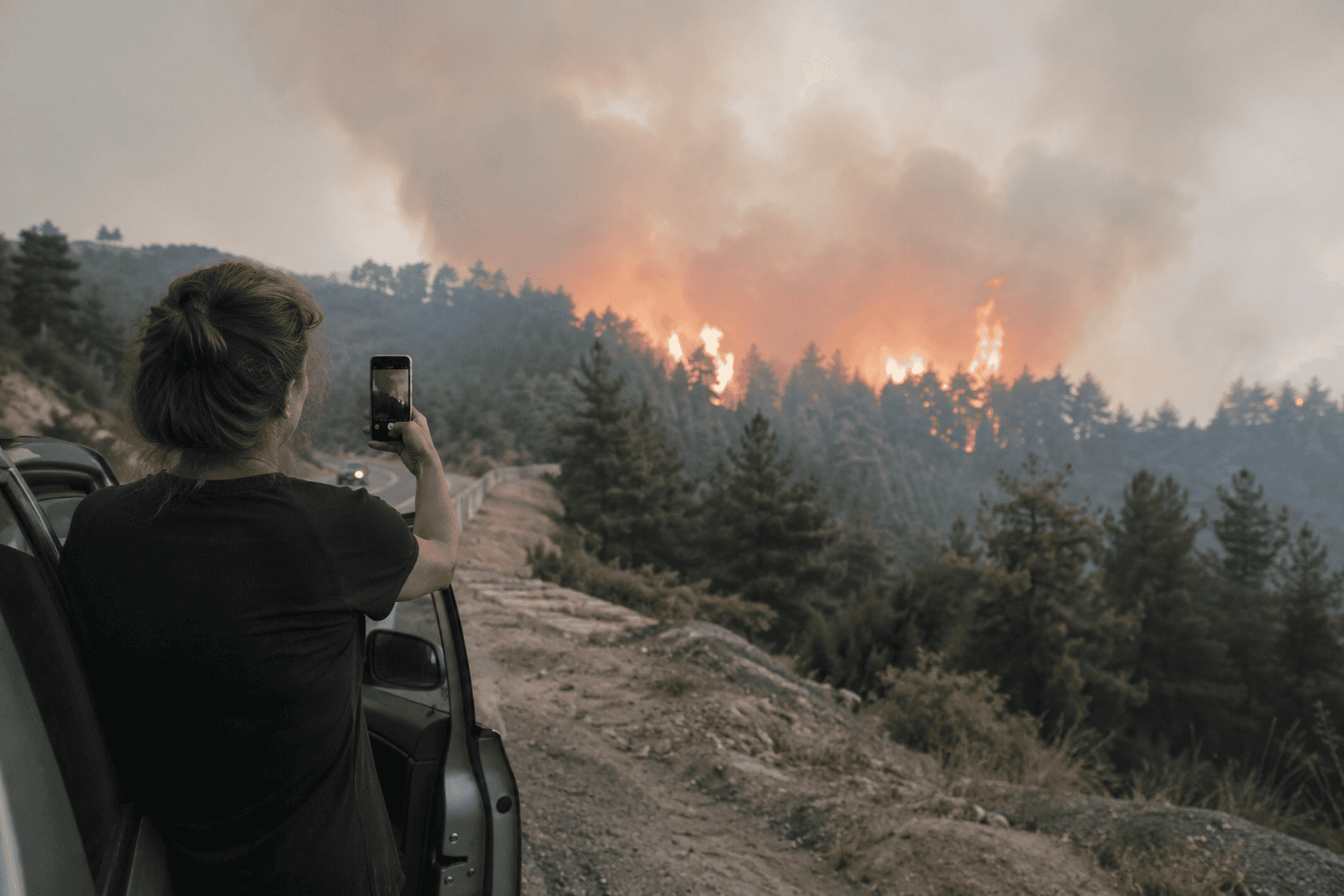
Witnessing a fire breaking out is therefore no longer something that only happens to people living in the Var or the Bouches-du-Rhône. Anyone can find themselves in that situation.
1. Raise the alarm immediately (and accurately)
This is the first thing to do, and by far the most important. If you see a fire breaking out, call 18 or 112 and try to pinpoint the exact location of the fire. People who are deaf or hard of hearing can send a text message to 114.
To ensure that the emergency services arrive quickly and at the right location, provide as much information as possible: the nearest town, the name of the path or road, your phone’s GPS coordinates, and any visible landmarks (high-voltage power lines, water tower, car park, etc.). Be as precise as possible about your location and the location of the fire; your smartphone can help you with this using location apps. French Hiking Federation
2. Under no circumstances should you try to put out the fire yourself
It’s a natural human reaction — and a serious mistake. Move away from the fire quickly, without trying to tackle it yourself. You could get hurt.
A bushfire can spread at several kilometres per hour and reach temperatures of several hundred degrees. Even a small fire can cause ‘flying embers’ (sparks and hot ash) that could catch you unawares in a matter of seconds.
3. Flee at right angles to the wind and the smoke
The direction of escape is important. Ideally, head off at a right angle to the smoke to reach open areas. Never try to run ahead of the flames: fire always spreads faster than a person can run, especially on a slope or in strong winds. French Hiking Federation
If caught in smoke, breathe through a damp cloth. Never stop to watch the fire. Do not block the roads.
4. If you’re travelling by car: do not get out; park in an open area
The natural instinct is to flee on foot. That’s a bad idea. If you find yourself in your car in the immediate vicinity of a forest or bush fire, do not get out; instead, drive to a clear area. In any case, never try to drive through a wall of flames or smoke.
Switch on your headlights (visibility is reduced by the smoke), close the windows and switch off the ventilation, and make sure the emergency services are aware of your presence.
5. If you are at home: stay indoors
Counter-intuitive but essential. According to the Home Office, a property with its surrounding undergrowth properly cleared remains your best protection. Only evacuate on the instructions of the authorities; turn off gas cylinders; close and wet down shutters, doors and windows; avoid creating draughts; and close internal doors. Fayaux-Loges Town Hall
Prepare a 72-hour emergency kit : a battery-powered radio to keep up to date with the latest developments and official guidance, a torch, medicines, identity documents, water and food.
The right tools for planning ahead
Before heading out to a high-risk area, it’s always a good idea to check the Forest weather, which provides a daily summary of the forecast risk level for the following day and the day after at departmental level. Four colours allow the risk to be identified at a glance: green (low), yellow (moderate), orange (high) and red (very high). A map, updated daily using public data from Météo-France and the prefectures, is freely available for consultation.
To find out more, visit our participatory platform feuxdeforet.fr — the first French community dedicated to this risk — enables everyone to report a fire in a matter of seconds and monitor current alerts in real time on a interactive map listing confirmed fires, fires to be confirmed and fires that have been extinguished. A free mobile app ‘Forest Fires’ (iOS and Android) complements the system with location-based push notifications as soon as an incident is detected near you. This citizen-reported information, which is subject to community moderation, usefully supplements official reports and saves precious minutes for the emergency services.
And next: what you risk if you start a fire
A cigarette butt that hasn’t been properly extinguished, a barbecue set up in the wrong place, an angle grinder left in direct sunlight… The penalties are severe. If you cause a fire in woodland, a forest or moorland, you face criminal penalties. In the event of an unintentional breach of a duty of care or safety, the maximum penalty is two years’ imprisonment and a fine of €30,000. If one or more people die as a result, the maximum penalty is increased to seven years’ imprisonment and a fine of €100,000.