









Since 21 May 2026, a persistent high-pressure system has been blocking a flow of warm air from Africa over France. As a result, temperature anomalies are averaging +6 to +8 °C across the country, and locally +8 to +10 °C, according to analyses from the European ECMWF model reported by Météo Centre.
Météo-France has confirmed the historic scale of the heatwave: the national temperature index reached 24.8 °C on Tuesday, making it ‘the hottest day ever recorded in May’. Nearly 400 weather stations broke their monthly records.
This Wednesday, 27 May, thirteen departments are under an orange heatwave alert, including Gironde, Charente, Charente-Maritime, Ille-et-Vilaine, Loire-Atlantique, Finistère and Côtes-d’Armor, whilst a total of 42 departments are subject to a heatwave alert, either yellow or orange.
What makes this so special? For the first time since the 19th century and the start of weather records, May has been hotter than ever before, reports France 3 Nouvelle-Aquitaine.
Why a heatwave causes the risk of fire to skyrocket: the mechanics in four steps
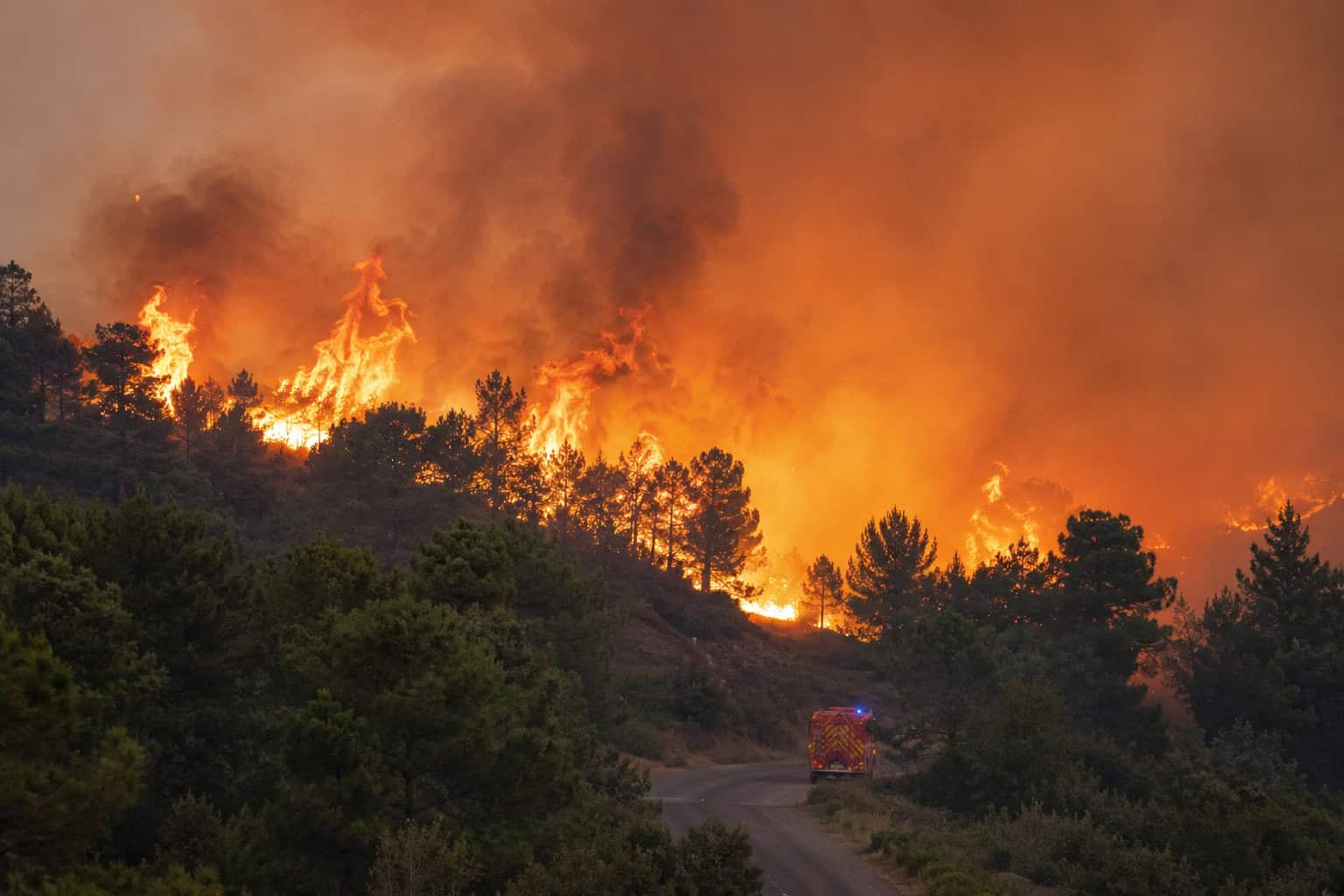
The link between extreme heat and fires is not merely statistical: it is thermodynamic. Here’s how, in practical terms, a heatwave turns a landscape into a powder keg.
1. Evapotranspiration is spiralling out of control
The warmer the air, the more it ‘draws’ water out. The Ministry for Ecological Transition points out that rising temperatures increase evaporation, which in turn intensifies the severity and duration of droughts. In practical terms, the soil and plants lose their water much more quickly than usual, and vegetation enters a state of water stress in just a few days.
2. The vegetation dries out whilst still standing
When there is a lack of water in the soil, plants close their stomata to limit water loss, and their tissues then dry out. The Senate report on the 2003 heatwave had already described this phenomenon in detail: the Mediterranean forest becomes a veritable ‘vegetation powder keg’; scrub is always present; it has dried out whilst still standing, has died, and constitutes a potential reservoir of combustible material. Dead biomass (pine needles, dry grass, undergrowth) becomes an ideal fuel.
3. The flammability threshold collapses
Dry vegetation catches fire at the slightest provocation. As the National Centre for Forest Ownership (CNPF) puts it: water shortages increase the vulnerability of vegetation and the risk of a fire breaking out – even the smallest spark becomes dangerous. A cigarette butt, a spark from a brush cutter, a shard of glass acting as a magnifying glass: all these are sources of ignition which, under normal circumstances, would not have been enough.
4. Fire spreads faster and further
Once it has started, the fire encounters a uniform, dry and abundant supply of fuel in its path. The UN points out that heatwaves and droughts create conditions conducive to the outbreak of forest fires, which then spread rapidly when they encounter dry, highly flammable vegetation.
The spring of 2026 trap: the vegetation is still green… but not for much longer
Paradox: following a particularly wet winter, the vegetation remains largely green, which is currently limiting the conditions conducive to fires starting.
It is precisely this combination of factors that makes the current situation particularly treacherous. The vegetation, saturated with water after a wet winter, has grown in abundance — creating a significant amount of combustible material. The current heatwave will dry it out in a matter of days, turning an asset into a threat. The first signs are already evident.
Please note: Météo-France’s ‘Forest Weather’ service, which publishes daily fire risk levels by department, will not resume its publications until June 2026. The official monitoring schedule is therefore out of step with the reality on the ground — a point that raises questions at a time when the fire season is becoming increasingly longer.
The geographical and temporal extent of the risk: what researchers are saying
What is at stake today goes beyond an isolated heatwave. INRAE confirms this: forested regions and the Mediterranean coast were traditionally the most at risk. But today, due to the drought, the risk has spread to the north and east of France. No French forest is spared.
The NGO Canopée summarises the scientific findings: the high-risk season will no longer be limited to July and August but will extend from May or June through to October, with more extreme fires. Under the most pessimistic scenario for GHG emissions, the area burnt in the Mediterranean region could triple.
The Ministry for Ecological Transition goes further: in a France where temperatures are set to rise by 4 °C by 2100, the risk of wildfires will become widespread across the whole country and will increase significantly.
The climate context: a signal, not an anomaly
Météo-France states this quite plainly: “With climate change, we expect to see such heatwaves with increasing frequency. They will occur earlier and earlier in the year and become increasingly intense.”. The European Copernicus service, cited by Consoglobe, recalled in April 2026 that “Europe has warmed twice as fast as the global average” since the 1980s, and that the "Heatwaves are becoming increasingly frequent and severe" across at least 95 per cent of European territory.
Globally, 2026 has already been marked by an unprecedented level of wildfire activity: since 1 January 2026, more than 150 million hectares of vegetation have been ravaged by fire across the globe, according to a warning from the United Nations (UN) issued on 12 May. The scientific data is even slightly more alarming: the total area burnt is estimated to have reached 163 million hectares as of 6 May, according to the Global Fire Information System. The WMO anticipates a probable return of El Niño as early as May–July 2026, which could further intensify the situation.
What can we do? Actions that save our forests
Important reminder: in France, 90 per cent of forest fires are caused by humans, either accidentally or deliberately; the remaining 10 per cent are caused by lightning. Individual prevention measures therefore have a direct impact.
During heatwaves and droughts, the government recommends: no fires or barbecues near forests or green spaces; compliance with bans on entering woodland; do not smoke in the forest or in the countryside, and do not throw cigarette ends on the ground or out of car windows; do not carry out work that could cause sparks near vegetation; do not store fuel (heating oil, wood, butane) against the house, as these are fire hazards.
If you are indicator of a fire starting : dial the following number immediately 112 (European emergency number) or the 114 (by text message for deaf and hard-of-hearing people).