














The fact
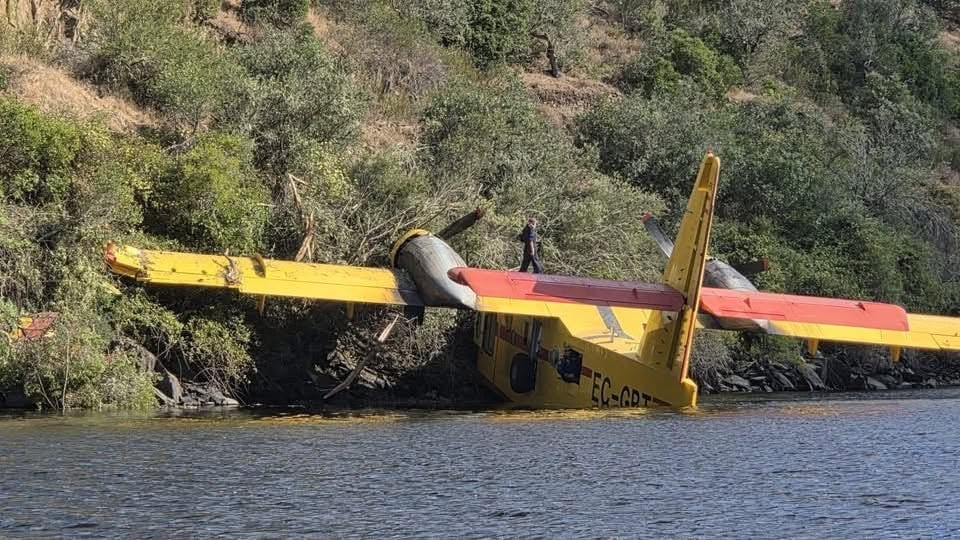
On Thursday 16 July 2026, in the late afternoon, a Canadair CL-215 registered as EC-GBT was scooping water from the Tagus, near Portas de Ródão, in central Portugal, around 200 kilometres north-east of Lisbon. Whilst manoeuvring, the aircraft suffered a technical fault and was unable to take off again. It remained afloat; the crew evacuated unharmed and no third parties were affected.
The Portuguese National Emergency and Civil Protection Authority (ANEPC) told the daily newspaper Correio da Manhã ‘a fault with the equipment during the manoeuvre to scooping ". The exact cause is not yet known.
Three things to understand before going any further
1. The Tagus: a river of strategic importance for firefighting. The Tagus, which is 1,038 kilometres long, rises in Spain, flows through Madrid, then crosses Portugal from east to west before emptying into the Atlantic at Lisbon. In its central Portuguese section, around Portas de Ródão, it features straight stretches that are wide enough to allow water-bombing aircraft to scoop up water. In a region of hills and pine and eucalyptus forests regularly ravaged by fires, it is a valuable operational resource.
2. The landing, the most delicate manoeuvre of the flight. Unlike Dash 8-type aircraft, which refuel on the ground, Canadair aircraft are amphibious: they descend to a few metres above the water’s surface, open hatches beneath the fuselage, and fill their fuel tanks — up to 5,400 litres — in around a dozen seconds, without landing. The manoeuvre requires precise speed and pitch, over a smooth body of water with no submerged or surface obstacles. The slightest error at this moment has immediate consequences.
3. A Spanish aircraft serving Portugal. The CL-215 in question belongs to the fleet of Avincis, a Spanish private operator specialising in emergency air services. Since 2025, Avincis has held a contract with ANEPC to provide three CL-215s based in Portugal — two on standby and one in reserve — as part of the DECIR (*Dispositivo Especial de Combate a Incêndios Rurais*), the Portuguese equivalent of our national French forest fire-fighting scheme. The contract runs until 2027.
A 1977 aircraft still in service
The EC-GBT is a Canadair CL-215-1A10, serial number 1054, which left the factory in 1977 — the aircraft therefore 48 years old. It is powered by two Pratt & Whitney R-2800 radial piston engines, an older-generation powerplant that has been replaced by turboprop engines on the CL-415.
This is no trivial matter: the CL-215s still in service in Europe are all ageing aircraft, and the question of their replacement — by the successor model, the DHC-515, production of which resumed in 2026 at De Havilland Canada — is a recurring issue in European civil protection budgets. For the record, the French Civil Protection Agency now operates only CL-415s (the famous ‘Pelicans’); the CL-215s were withdrawn from service in France in 1996.
Why this incident matters
In the very short term, the grounding of one of Avincis’s three CL-215s reduces the Portuguese operation’s room for manoeuvre at the worst time of the year. The Iberian Peninsula, like the French Mediterranean coast, experiences a period of intense wildfires in July and August. The reserve CL-215 can step in, but there is no longer a net.
In the medium term, there are two key issues:
- The cause of the breakdown. If this is a fault linked to the age of the airframe or engines, it could lead to an inspection of other European CL-215s, resulting in a knock-on effect of groundings. A similar incident occurred in the summer of 2016, when the failure of a landing gear strut on ‘Pélican 42’ in Ajaccio led to a rapid inspection of the entire French fleet.
- Collection of the device. Pulling a CL-215 that has made an emergency landing on a river out of the water is no easy task. The operation could take several weeks, and the aircraft may not be airworthy again before the end of the season.
A bleak summer for the European fleet
The incident in Portugal is not an isolated one. In the space of two weeks:
- 10 July, Sardinia : An Italian CL-415 collided in flight with the cable of a Super Puma helicopter’s *bambi bucket* whilst both were tackling the same fire; the smoke had made the helicopter invisible from the cockpit. The right wing was nicked, but disaster was narrowly averted by a matter of metres.
- 24 June, Quebec City : A Canadian CL-415 punctured its fuel tanks on a protruding rock whilst bailing water in the La Grande Rivière area.
- 13 July, the Paris region : for the first time in history, Civil Protection’s Dash 8 and Canadair aircraft have been deployed to tackle a fire in the Île-de-France region — a sign that the risk is spreading northwards.
Key takeaways
An ageing aircraft, a high-risk manoeuvre, a strategic river and a European response system whose redundancy is reduced a little more each summer. Fortunately, the Tagus incident claimed no lives, but it highlights, by implication, the constant strain placed on the aerial resources used to combat forest fires in southern Europe. Investment decisions – such as fleet replacement and pooling of resources via the European rescEU mechanism – are taken in ministerial offices far removed from the banks of the Tagus, but their consequences are all too evident in the midst of the fire season.
We will provide an update on this incident as soon as the Portuguese authorities have released their initial technical findings.
---
Sources: Aviación Digital, Aircraft Rescue Fire Fighters Working Group, Aviation Safety Network, Correio da Manhã, Aerobuzz.
Photo to be added — credit must be given.